SCOTT Spark

BikeRide finds and shows you the best prices of the bikes you want to buy. Prices constantly change and it’s impossible to compare them all yourself.
We search for prices on over 120 bike retailers to guarantee that we find the lowest prices – to save you time and money.
It’s a promise we stand behind: If you find a lower price on a bike elsewhere, we will sell it to you for 10% less. For example, if you find a bike for $480 that we have listed at $500, we will offer you to buy it for $432 through BikeRide. The bike must be the same color and size, sold in the US and not include the use of a coupon.
If you find a lower price, email us at [email protected] with documentation of the price. We’re committed to making sure that the cost of a bike does not keep you from cycling!
Facts
Summary of Reviews
We have read all expert and user reviews on the SCOTT Spark. In summary, this is what cyclists think. Published Sep 16, 2025 by Reda Ashour.
12 reasons to buy
- The Spark comes in multiple builds with options for both aluminum and carbon frames.
- SCOTT's three-mode TwinLoc suspension and remote lever allow riders to adapt the suspension to different trail situations on the fly.
- Experts are impressed with the Spark’s pedaling efficiency.
- Testers say the Spark excels at climbing, in part due to its geometry and adjustable suspension modes.
- The Spark confidently handles moderately steep descents in testing.
- Testers say shock setup is hassle-free, and the frame integration keeps it protected and adds to the bike's sleek look.
- Experts relish the Spark's cornering performance.
- A reviewer appreciates how the balanced feeling while airborne instills confidence to tackle bigger jumps.
- Testers of the Spark love the lightweight and agile ride.
- Most reviewers praise the FOX NUDE 5T/6T EVOL Trunnion shock (910, 920, 930) for balancing suppleness with good support.
- The headset cups can be angled to provide a +/- 0.6° offset. Reviewers prefer the stock 65.8°.
- The frame has seat tube bottle cage mounts, down tube 3-pack mounts, and can accommodate up to 2.6” wide tires and a 40t chainring.
8 reasons not to buy
- The clustered TwinLoc remote causes testers to accidentally hit the wrong lever.
- Reviewers feel the suspension could just be tuned better instead of having to switch suspension modes while riding.
- Two reviewers dislike the “weird” handlebar shape, and two others find them too narrow (760mm).
- A reviewer says the suspension pivots creak and the rear derailleur cable rattles in the frame of their Spark 910 test bike.
- Experts recommend avoiding the steeper head angle position, as it makes the handling too lively.
- The proprietary integrated cockpit limits adjustability for fit.
- The only differences between the men's and women’s builds (Contessa) are the saddle and grips.
- A reviewer riding with the suspension in open mode complains of pedal bob and pedal strikes.
Bottom line
The Spark is SCOTT's high-travel cross-country MTB with 130mm front and 120mm rear travel from a frame-integrated rear shock. Buyers can choose aluminum or carbon frames from the various builds. The Spark's remote-controlled TwinLoc suspension system allows riders to switch between three modes: descend, traction, or lockout. This system is divisive, as some reviewers enjoy the adjustability, but others are disappointed that the bike relies on its use. It also limits suspension upgrade options. Nimble handling, outstanding pedaling efficiency and climbing characteristics, and confident descending impress experts, who for the most part, recommend the Spark, especially the value-packed 930 build.Expert Reviews
83/100 based on 4 rated expert reviewsSCOTT Spark 970 Review – Impressive Long-Travel XC Bike, but Is It Right for You?
The SCOTT Spark is a high-travel XC mountain bike, or downcountry bike, as the brand calls it.
Testers of higher-end Spark builds, such as the 910, 920, and 930, praise the trail performance and climbing ability, but how does the entry-level Spark 970 compare?
In this review, we’ll find out if it’s a good choice for riders who want to keep initial costs down, or if it’s worth spending more up front.

Assembly and Setup
Unboxing the Spark is easy. There’s no need to lift the bike out of the box; just open one end and slide out the cardboard tray. The Spark comes with a tool kit, a shock pump, and assembly documents. SCOTT also has an assembly video on YouTube.
The bike comes mostly assembled. To finish, align and tighten the stem, install the wheels, and check bolt torques.
Our test bike arrived with everything assembled correctly, all components set up properly, and grease applied in the appropriate places.
Bike Description
SCOTT describes the Spark 970 as a “lightweight and ultra-capable” short-travel trail bike, but it could also be considered a high-travel XC or downcountry bike. One thing is clear, however: the Spark looks great. The tan tires and matching saddle complement the clean, modern frame design and slick blue paint job.
We’re testing Large frame, but the Spark also comes in Small, Medium, and XL. The geometry suggests a well-rounded trail bike.
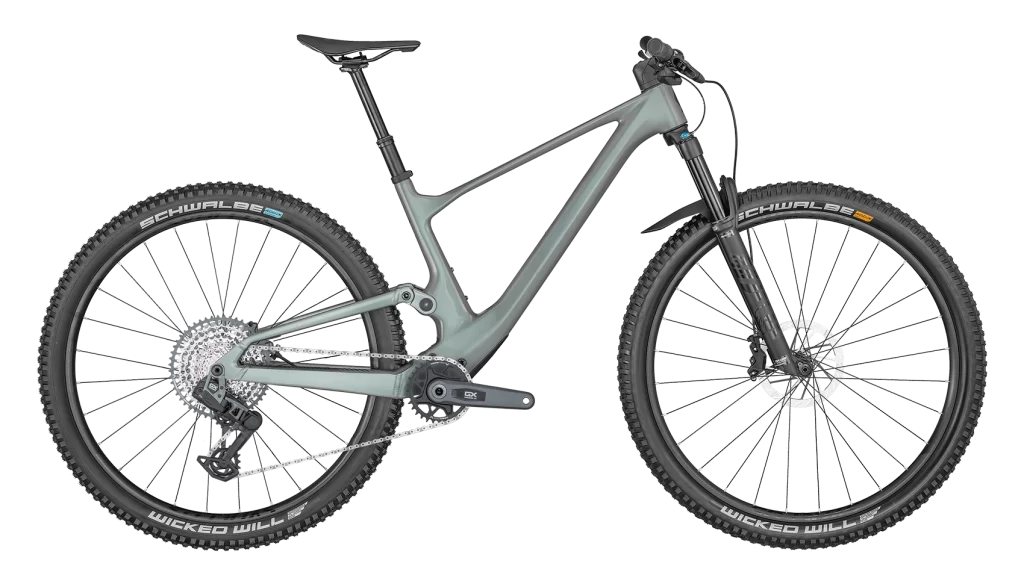
The Spark 970 has an aluminum frame, with single-pivot rear suspension and 120mm of travel. SCOTT has done a great job of hiding the X-Fusion NUDE 5 shock inside the frame at the base of the seat tube. Here it’s protected from muck thrown up by the rear tire. This integration, together with the internal cabling, adds to the sleek look. Up front is a 130mm RockShox Judy Silver fork.
Rebound and air pressure can be adjusted on the fork and shock, and compression is managed using the TwinLoc system. The TwinLoc lever above the dropper lever offers three ride modes. The three settings are Descend, Traction Control, and Lockout.
This easy on-the-fly adjustment is great, but the TwinLoc system limits upgrade options, as it requires a special damper and control unit only available on SCOTT bikes. The shock’s location inside the frame also limits upgrades because SCOTT’s custom NUDE-style shocks have a bespoke air valve.
Our fully assembled, size-large Spark 970 weighs 32.96lb without pedals. This is pretty good weight for a low-travel aluminum trail bike in this price range, especially when compared to models with the same travel. For example, the carbon-framed Santa Cruz Tallboy and Trek Top Fuel 8 weigh 31lb and 32.15lb, but cost a lot more.
The 29” wheelset is made up of Formula CL hubs and Syncros X-30SE aluminum rims. The 30mm internal width pairs nicely with the 2.4” Schwalbe Wicked Will tires. The rims are tubeless-ready, but the tires aren’t. Non-tubeless-ready tires really seem like a waste of space here and need to be upgraded.
The Spark 970 has a SRAM SX drivetrain and NX derailleur. The 12-speed 11-50t gearing provides plenty of range for climbing and delivers reliable performance on the trails. A full-length rubber guard protects the chainstay from chain slap.
The brakes are Shimano hydraulic discs with MT201 levers and SM-RT10 CL 180mm rotors. I was disappointed to see that these rotors aren’t compatible with metallic pads, which I’ve found to offer significant benefits over resin.
The Syncros Fraser 2.0 handlebar sweeps up and back. I liked this shape on climbs, but not so much on descents. However, once I got used to this handlebar, I found the 760mm width provided stability at speed and plenty of leverage in turns, without hindering maneuverability as I squeezed between trees. The Syncros integrated stem directs the cables into the frame, and the Syncros Acros Angle Adjust Headset allows users to adjust the head angle from the stock 65.8° to a steeper 66.4°. It’s easy to do: just remove the handlebar and spacers, and rotate the headset cups 180°.
The cockpit has the SRAM SX trigger shifter on the right, the three levers for the Twinloc and dropper post on the left, and Syncros Performance XC lock-on grips. The in-house saddle sits on a dropper with 150mm of travel (L and XL frames).
There’s a pair of bottle cage bosses on the seat tube and a set of three-pack bosses on the down tube.
Riding the SCOTT Spark
SCOTT recommends 25% suspension sag for general trail riding. I tried the bike with 25% and 30%, before finding the ideal setup for my riding style and weight (200lb) with sag at around 27.5%, fork at 106psi, and shock at 165psi. This “sweet spot” of 27.5% sag gave me full suspension travel without the shock bottoming out.
I ran the tires at 24.5psi in the front and 25.5psi in the rear. I set rebound at 4/5 steps from slowest on the fork and 3/6 steps from slowest on the shock.
In testing, I took the Spark 970 on a range of trails from wide, grinding doubletrack climbs to tight XC singletrack, and some moderate-to-advanced flow and tech descents.
I found it to be an effective climber. It accelerates quickly and maintains speed easily. The 76.4° seat tube angle positions the rider over the cranks, which helps with power transfer.
The seated position is comfortable whether climbing or powering through an XC trail, and the bike feels light and responsive. I had no problems maneuvering the Spark, whether I was working technical low-speed sections or carving into corners at higher speeds.
Given the Spark 970’s XC designation and relatively low-cost suspension components, I was surprised by its descending performance. The long wheelbase and 470mm reach gave the bike a stable, planted feel at speed and made it easy to control through rough downhill trail sections. The Spark felt well matched to the blue and black flow trails I took it on, and I found myself comfortably taking on descents that I wasn’t expecting to ride.
I experimented with both head angles, but preferred the stock 65.8° setting, as the quicker steering with the steeper 66.4° head angle reduced confidence in descents and high-speed cornering.
The TwinLoc system provides three suspension settings while riding: Descend, Traction Control, and Lockout. I generally moved between Descend and Traction Control, occasionally using Lockout on smooth doubletrack climbs. Traction Control mode stiffens the fork and shock, and limits rear travel to 80mm. This setting provides some suspension travel to smooth out rocks and roots, while maximizing power transfer, making it great for climbs and fast XC terrain.
The bike carves stable arcs at high cornering speeds with reasonable traction in most circumstances. However, over terrain like large rocks and gravel, the bike was getting thrown around, and the tires lacked grip on wet rocks and wood.
Wicked Will Performance is the cheapest version of this Schwalbe tire, and I would love to see how this bike performs with the much better Wicked Will SuperTrail with ADDIX SpeedGrip set up tubeless. The softer compound, firmer casing, and lower tire pressure could remedy some of my complaints.
The stock Shimano disc brakes are fine for XC riding and trails, but the Spark is so good at descending that I soon found the limits of the two-piston calipers and resin pads. On some local blue and black trails I know well, the brakes held me back; I found myself entering corners faster than I expected, and I struggled to brake hard on steep descents without locking up the wheels. To feel in control, I had to reduce my speed and brake earlier than usual.
Despite my reservations about the brakes, I was impressed with the Spark 970. It’s a versatile and capable bike that’s responsive and quick on climbs, and just as fast and confident when descending.
Pros
Pedal Efficiency and Climbing
The Spark 970 has great pedal efficiency and climbing capability. It accelerates quickly and maintains speed well. The steeper seat tube angle puts the rider in an efficient pedaling position, whether tackling punchy singletrack climbs or long doubletrack grinds, making climbs almost as much fun as descents.
Cornering and Descents
I normally ride an enduro bike with a 170mm fork and 150mm of rear suspension travel, and I like riding fast, technical trails, so I was surprised by the Spark 970’s confidence navigating some pretty steep trails that included jumps and small drops.
As I continued to explore, I found that contrary to this bike’s XC designation, I had no problem tackling blue flow and tech and black flow trails without feeling like I was exceeding the Spark’s limits. Even though it’s an entry-level option, the Spark 970 can handle an impressive range of trails.
Appearance and Integration
This bike looks fantastic. The integrated shock and internal cabling create a slick appearance. The tan tires and brown seat contrast nicely against the dark blue frame and black components.
Cons
Brakes
Because the Spark 970 is so capable downhill, it’s easy to get into situations where the brakes fall short. The Shimano brakes lack the power and control needed for steep, fast trail sections. I had to keep my speed lower and brake earlier than I’m used to. The rotors are only compatible with resin pads, so swapping to a metallic compound requires changing rotors, however, this upgrade should significantly improve braking.
Upgrades and Maintenance
The hidden shock and TwinLoc suspension adjustment are nice touches, but they limit the options for upgrading the suspension.
TwinLoc uses special dampers and control units on the fork and shock, and the air valve on the shock is a custom design required to work with this frame. These forks and shocks aren’t available in the aftermarket, and it appears that SCOTT won’t sell upgraded parts separately, so the only options are to source used parts or give up TwinLoc, and even then, the shock’s air pressure won’t be adjustable.
If there’s a risk of the Spark 970’s suspension being a limiting factor, a higher-end Spark build may be a better choice.
Conclusion
So, is the Spark 970 a good choice for budget-conscious riders who want to upgrade as they progress? The answer is complicated.
The Spark 970 delivers where it matters most. It’s a great climber, accelerates quickly, and maintains speed with impressive pedal efficiency. The bike’s confidence and stability on descents and a range of aggressive trails surprised me. For an entry-level XC bike, it’s very impressive.
The TwinLoc system is very useful and further enhances the bike’s versatility, and the Spark just looks great.
On the other hand, the Shimano brakes can’t keep up with this bike’s capacity for descents, but a new set of rotors and some metallic pads could help a lot, without costing much.
The most important consideration for buyers is the limited upgradability of the suspension. SCOTT’s proprietary TwinLoc system and frame design severely reduce upgrade options.
The Spark 970 is a capable, good-looking XC bike that performs well on varied trails. It retails for around $2,599, but has been on sale for as low as $1,200. For those who will make only minor upgrades to things like tires and brakes, this bike offers great value, especially when it’s on sale.
Score Breakdown
- Build quality: 80
- Performance/Innovation: 90
- Design: 90
- Ride quality: 85
- Price/Value: 85
Overall: 86
Detailed Specifications
Frame: Spark Alloy SL 6011
Fork: RockShox Judy Silver TK Solo Air
Fork Travel: 130mm
Rear Shock: X-Fusion NUDE 5 RLX Trunnion, T165x45mm
Frame Travel: 120mm
Remote System: TwinLoc 2 Technology, Suspension + Dropper Remote
Rear Derailleur: SRAM NX Eagle
Shifters: SRAM SX Eagle Trigger
Crankset: SRAM SX Eagle DUB 55mm CL, 32t
BB-Set: SRAM DUB PF 92 MTB Wide shell 41x92mm
Chain: SRAM CN SX Eagle
Cassette: SRAM SX-PG1210, 11-50t
Brakes: Shimano MT201 Disc
Rotor: Shimano SM-RT10 CL, 180mm
Handlebar: Syncros Fraser 2.0 DC Alloy 6061 D.B., 8° sweep, 760mm
Grips: Syncros Performance XC lock-on
Stem: Syncros DC 3.0
Seatpost: Syncros Duncan dropper, 150mm travel
Seat: Syncros Tofino 2.5 Regular
Headset: Syncros – Acros Angle adjust
Hub (Front): Formula CL-811, 15x110mm
Hub (Rear): Formula CL-3248, 12x148mm
Spokes: Stainless Black 15G, 1.8mm
Rims: Syncros X-30SE, 32H, 30mm
Tires: Schwalbe Wicked Will 29×2.4″ Performance / Addix
Tubes: Maxxis Ultra Thin
Payload Capacity: 282lb
Component Weights
Total Weight 14.95 kg – 32.96lb
Frame, Shocks, Brakes, Cockpit: 7,730g – 17.04lb
Drivetrain Total: 2101g – 4.63lb
SX Eagle 10-50T Cassette: 720g
Cranks: 791g
Derailleur: 340g
SX Chain: 250g
Front Wheel Complete: 2,250g – 4.96lb
Rear Wheel Complete: 3,003g – 6.62lb
Rotor: 211g
Tube (Maxxis Super Thin): 158g
Front Rim and hub: 787g
Rear Rim, hub, and freehub: 865g
Tire 753g
Geometry Details
Size: Large
Seat Tube: 19.29“ (490mm)
Reach: 18.50“ (470mm)
Stack: 24.31” (617.7mm)
Stand Over Height: 30.62” (778mm)
Virtual Top Tube Length: 24.13” (613mm)
Stem Length: 60mm
Trail: 4.21” (107mm)
BB Height: 13.05” (331.5mm)
Head Tube Angle: 65.8°
Seat Angle: 76.4°
Wheelbase: 47.44” (1205mm)
SCOTT Spark 910 Review – Potentially Perfect for Trail Riders With a Race Vibe
SCOTT Spark 940 Review
Review | Scott Spark 910: To Infinity and Beyond [French]
2022 SCOTT Spark Review | An All-Round XC Ripper With a Split Personality
Vital Test Sessions – SCOTT Spark 910
Review: SCOTT Spark 910
Is This Peak Downcountry? A Review of the SCOTTSpark 910
SCOTT Spark 920 TR Review: Popular Trail Bike for Fast Tours [German]
Cross-Country Trail Bike: SCOTT Spark 910 Endurance Test – 3,735Km Conclusion [German]
SCOTT Spark, More Affordable and With a Downcountry Focus [Spanish]
Rankings
Best Mountain Bikes
Bike Comparison
Forum Discussions
-
2 hours ago
-
19 hours ago
-
20 hours ago