The BikeRide Score
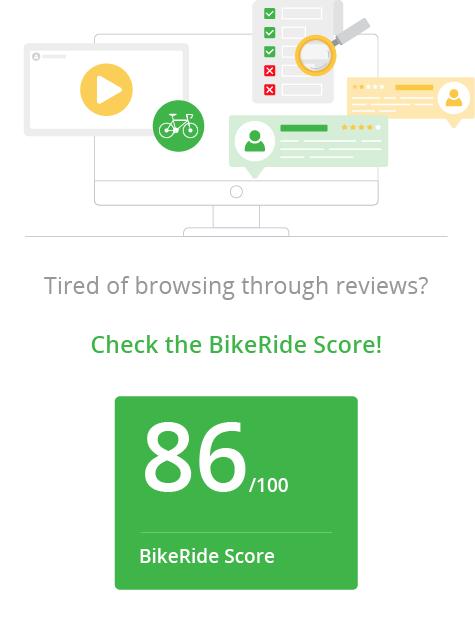
The BikeRide Score ranks bikes, parts and accessories from 0-100 to indicate how much they are liked by users and experts. The score is calculated based on reviews from all online sources. The exception is bikes we have tested first-hand: those carry an in-house score built entirely from our own measurements and ratings, documented in BikeRide Methodology 1.0.
How the BikeRide Score is Calculated
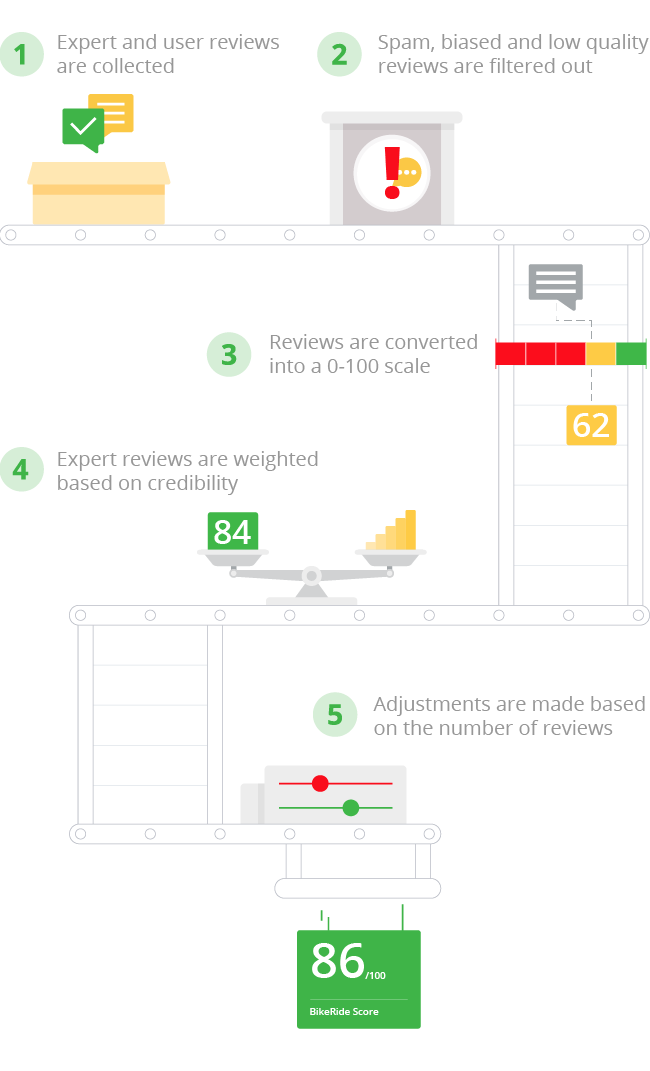
To calculate the BikeRide Score, we gather all expert reviews and user ratings that can be found online. We calculate the average of all reviews and ratings from 0-100. We then adjust the score based on the credibility and experience of each expert and the number of user and expert ratings. Low quality or biased reviews and spam ratings are filtered out.
User Ratings
Anyone can add a user rating for a bike, part and accessory that he or she has tried. We also gather ratings from other reliable online sources.
A product with fewer user ratings offers a less reliable score, as it is the opinion of only one person or a few people. To prevent products with fewer user ratings from reaching the top of our ranking lists, we subtract up to 12% from the user rating. The deduction shrinks with every rating added, in straight lines between these points:
- 1 user rating: subtract 12%
- 50 user ratings: subtract 6%
- 75 user ratings: subtract 3%
- 100 or more user ratings: no adjustment
Expert Reviews
We include expert reviews that are either published on BikeRide or on other websites.
Expert reviews are converted into the scale of 0-100. For example, an expert rating of 6/10 becomes 60/100 and an expert rating of 4/5 becomes 80/100.
We assign experts a level between 1 and 5 based on the knowledge they demonstrate in their reviews.
The higher the level, the more the review is weighted in the expert score calculation:
- Level 1: 100%
- Level 2: 200%
- Level 3: 300%
- Level 4: 400%
- Level 5: 500%
This adjustment is made to account for the level of expertise a reviewer has, so ratings from bike industry experts are given more weight than those from casual reviewers.
Unrated Expert Reviews
For expert reviews that do not have a rating we use the following framework alongside the experience of our writers to build a rating, so that these reviews can be included within our algorithm. This bike model is made up for demonstration purposes:
Quasi Faux-Faux 2.0 (2024):
- Build quality: 90
- Performance / Innovation: 80
- Design: 80
- Ride quality: 90
- Price / Value: 78
Average rating: 84/100. This is used as the rating of the expert review.
Quality, Unbiased and Spam-Filtered Ratings
Some brands try to manipulate the BikeRide Scores by adding positive user ratings to their own products. In order for us to avoid this score manipulation, we have built several filters to detect and filter out spam. This includes IP user restrictions and other filters that check for certain patterns. We also manually monitor all user ratings.
We go through each expert review to make sure that it is unbiased and of high quality. This is done manually. We also disregard reviews that we judge as biased. This includes situations where the focus is on promoting a product in return for a free sample or commission, rather than on impartiality. Elsewhere, some ‘reviewers’ may write low-quality ‘reviews’ of products without having tested them. We have high standards. If we are not certain that an expert review is unbiased and of high quality, then we do not include it.
The Final Score Calculation
The final BikeRide Score calculation is made by weighting the expert reviews and user ratings. The weight of the user ratings grows evenly with the number of ratings, from 5% at a single rating to 25% at 25 ratings and 50% at 50 or more ratings, and the expert reviews carry the rest. This adjusts for the less reliable score given by fewer user ratings:
- 1 user rating: user ratings 5%, expert reviews 95%
- 10 user ratings: user ratings 12.5%, expert reviews 87.5%
- 25 user ratings: user ratings 25%, expert reviews 75%
- 50 or more user ratings: user ratings 50%, expert reviews 50%
A product with only expert reviews gets its score from the expert reviews alone. A product with only user ratings and no expert review gets its score from the user ratings, minus 3%.
We also make the following adjustments when making the final score calculations:
- If no level 4 or 5 expert has rated the product, we subtract 5% from the expert rating. The deduction shrinks as a larger share of the expert rating comes from level 4 and 5 experts: with one level 5 review among three level 1 reviews it is about 2%. Expert reviews without a rating do not count here.
- If a product has only one rated expert review, from a level 4 or 5 expert, and no user ratings, we subtract 2% from the expert rating. A single level 1-3 review already gets the 5% above.
- For every expert review with a rating we add 1.2% to the score, up to 6% at five or more expert reviews.
These adjustments are made because scores based on many expert reviews, and on reviews by our most experienced experts, are more reliable.
An example with three expert reviews (levels 1, 1 and 5, rated 80, 85 and 85) and 10 user ratings averaging 90:
| Expert rating, level-weighted | 84 |
| Level 5 expert holds 5 of the 7 weight points (71%); the 5% deduction applies to the other 29%: subtract 1.4% | 82.8 |
| User rating 90, 10 ratings: subtract 10.9% | 80.2 |
| Weighted 12.5% users / 87.5% experts | 82.5 |
| Three expert reviews: add 3.6% | 85.4 |
| BikeRide Score | 85 |
The color of the BikeRide Score depends on how high the score is:
- 80-100: Green
- 60-79: Yellow
- 00-59: Red
Potential Flaws in the BikeRide Score
The BikeRide Score is built to be as useful and reliable as possible for readers. There are, however, some potential flaws to discuss:
- The BikeRide score is calculated based on reviews and ratings from many online sources. When experts and users choose their ratings they consider how good a product is, but they also consider the value you get in comparison to the price of the product. This affects the BikeRide Score, meaning that a high score does not always mean that a product is better than a product with a lower score. It can just mean that it is a great product, based on its price.
- Brands have a special interest in seeing high scores on their own products and low scores on all other brands. They may try to manipulate the score by adding extra user ratings. We have built filters to detect and delete this type of spam, as discussed under “Quality, Unbiased and Spam Filtered Ratings”.
- Experts may write biased reviews because they receive free samples, or write low quality reviews without testing the products first. We have high standards. If we are not certain that an expert review is unbiased and high quality, then we do not include it. This means that the BikeRide Score does not include all reviews and ratings but it does include those that we deem to be fully trustworthy.