Ford Bronco E-Bike Review


Our verdict
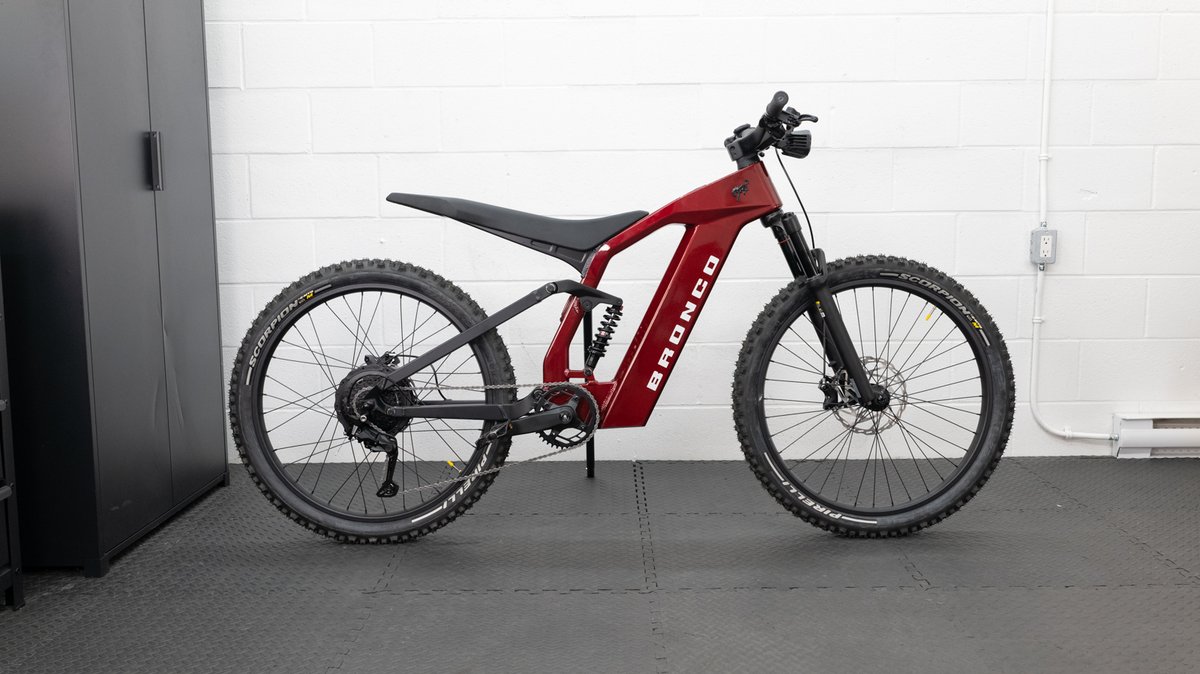
The Ford Bronco E-Bike is a full-suspension, moto-style e-bike designed by n+ and sold by Ford. Its suspension was adequate for dirt paths, mild gravel and logging roads, but it won't go over all terrain the way Ford claims. The pedaling position is the worst we have dealt with in a while, and the throttle provides limp, unremarkable assistance: the slowest in our comparison group. Range was the one standout test result, at 31.35 miles. The three cheaper comparison bikes matched or beat the Bronco in most areas, so you're paying for the branding.
Pros
- 31.35 miles of range at max assist
- Comfortable over light gravel, logging roads, and easy dirt paths
- Pirelli Scorpion tires grip well
- Display is readable in bright sunlight
- 2,000-lumen headlight with two beams is among the brightest we've measured
- Lightweight for a moto-style e-bike
Cons
- Unsuitable for the claimed terrain and riding style
- Slowest acceleration in the comparison group
- Cramped pedaling position and torque sensor make the 28 mph top speed hard to reach
- Poor IPX4 water resistance rating
- No fenders, kickstand, or app to tune motor settings
Claimed vs. measured
Ford's marketing promises trail-ready performance to match the SUV's off-road heritage ("approach the trail or adventure with ease", "confidently negotiate obstacles and land jumps"). We checked the claims we can measure against our instruments. Here is the spec sheet next to what we measured:
| Claim | Ford says | We measured | Verdict |
|---|---|---|---|
| Top speed | 28 mph (Class 3) | 28.0 mph (GPS) on pedal assist | ✓ Verified |
| Weight | 68 lb | 72.4 lb as shipped | ✗ Misleading |
| Range (max claim) | Up to 60 mi | 31.35 mi at max assist, mostly on the throttle | ✓ 52% of claim |
| Charge time | 3.5 h | 5 h, calculated from the 3A charger | ✗ Misleading |
| Rider height range | 5'7"–6'0", one size | Realistic, but only for throttle riding | ≈ For throttle riding |
| Fits our tester (6'0", 33" inseam) | 6'0" is the top of the claimed range | Yes, for throttle riding. Like all motorcycle e-bikes, pedaling is cramped | ≈ With caveats |
| Claimed height range accuracy | A 5" span of rider height on 2.5" of effective seat adjustment | (5" − 2") ÷ 2.5" = 1.2×, inside our 2.0× limit | ✓ Verified |
| Terrain | "Heavy-duty" suspension for "any type of terrain" | Not suitable for technical or aggressive terrain | ✗ Misleading |
✓ = within tolerance · ≈ = close, with caveats · ✗ = fails our tolerance. Tolerances are defined in our test methodology. Motor output (750W) and the 85 Nm torque figure are Ford's published numbers and are not dyno-tested. The 287 lb payload rating was not tested.
Comparison
The most similar e-bikes we have tested first-hand, compared side by side using our own measurements and test results where possible.
This bike Ford Bronco |
 n+ Mercedes-AMG Petronas F1 Team Rallye Edition |
 Revibikes Cougar |
 MEELOD DK300 |
|
|---|---|---|---|---|
| BikeRide Score | 71 | 70 | 74 | 75 |
| Best price | $4,000.00 | $7,000.00 | $1,350.00 | $999.00 |
| Motor | 750W rear hub | 750W rear hub | 750W rear hub (1,600W peak) | Dual 750W hubs (2,400W peak) |
| Battery | 720 Wh, integrated | 720 Wh | 1,200 Wh | 1,920 Wh, dual |
| Range tested (max assist) | 31.35 mi | 32.41 mi | 38.08 mi | 33.25 mi |
| Gradual hill climb | 3:03 20 mph cap | 3:03 20 mph cap | 3:16 20 mph cap | 2:10 uncapped |
| Steep hill climb | 2:27 | 2:31 | 2:16 | 1:51 uncapped |
| 0–20 mph (throttle) | 11.0 s | 11.0 s | 6.0 s | 7.0 s |
| Brake 20–0 mph | 19.5 ft | 20 ft | 14 ft | 16 ft |
| Measured weight | 72.4 lb | 69.4 lb | 88.0 lb | 126.0 lb |
| Payload | 287 lb | Not published | 350 lb | 440 lb |
| Top speed | 28 mph (GPS-verified) | 28 mph | 38 mph | 35 mph |
| Torque (claimed) | 85 Nm | 85 Nm | 110 Nm | 2×80 Nm (160 total) |
| Charge time | 5.0 h | 5.0 h | 5.0 h | 8.9 h |
| Suspension | 120 mm air fork + coil shock | 80 mm air fork, hardtail | 60 mm inverted fork + coil shock | 100 mm coil fork + coil shock |
| Drivetrain | 9-sp Shimano CUES | Pinion 9-sp gearbox, belt | Single-speed | 7-sp Shimano Tourney |
| Tires | 27.5×2.6″ Pirelli Scorpion | 27.5×2.6″ Pirelli Scorpion | 20×4″ Inova | 20×4″ CST Scout |
| Frame | Aluminum | Aluminum | Aluminum | Steel |
| Assist sensor | Torque | Torque | Cadence | Cadence |
| Water rating | IPX4 (bike) | IPX5 (motor) | IPX6 | IPX4 (bike) |
| Certification | UL 2849 + UL 2271 | UL 2849 + UL 2271 | UL 2849 + UL 2271 | UL 2849 |
Who should buy the Bronco
We believe the Ford Bronco E-Bike may satisfy:
- Bronco owners who want a brand-matched bike. For the campground and easy trails, the suspension is comfortable on dirt, mild gravel and logging roads.
- Throttle riders who value range. Ridden mostly on the throttle at max assist, we covered 31.35 miles, the one test result that impressed us.
Who should NOT buy it
- Anyone who wants true performance or off-road capability. Slowest acceleration in the group, middle-of-the-pack on climbs, and we wouldn't take it anywhere technical.
- Riders who like to pedal. The low fixed seat and long reach gave us sore knees, and the torque sensor requires hard pedaling to get near 28 mph.
- Riders outside 5'7"–6'0". One frame size and one seat, with 33 to 35.5 inches of effective seat height found by sliding along the saddle.
- Rain-or-shine riders. The bike is rated IPX4: avoid heavy rain and deep puddles.
Before you buy: the badge and the bike underneath
The Bronco tested poorly and, though comfortable over light off-road terrain, failed to live up to Ford's claims. What we found while verifying the claims:
- Ford's name is on the frame, but n+ builds the bike. n+ is a relatively new company in the e-bike space, so long-term warranty and customer support are unknowns, and the proprietary components may be hard to source in the future.
- "Heavy-duty" and "any type of terrain" are misleading marketing. The suspension smooths bumpy pavement, dirt paths, and mild gravel well, and more comfortably than we expected from inexpensive hardware, but we wouldn't take the bike anywhere technical, and we wouldn't ride any of the trails where we ride our mountain bikes.
- Plan for 72.4 lb, not 68. The bike ships without fenders, rack or kickstand, and our scale still read 4.4 lb over the claim.
- Plan for a 5-hour charge, not 3.5. A 15Ah battery on a 3A charger needs 5 hours at the fastest, so the 3.5-hour claim is not possible with the included charger.
- IPX4 for an adventure bike. The motor is rated IPX5 and the electronics IP66, but the bike as a whole is IPX4, so heavy rain and deep puddles are out.
None of this makes the Bronco a bad bike on easy ground. It makes it a bike whose price buys the badge: three of the four bikes in our comparison group matched or beat it in most of our tests, and they sell for a fraction of the price.
How we test
Every e-bike we review goes through the same standardized tests, performed the same way, on the same documented courses: range tests to motor shutoff, two hill climbs, acceleration, braking, a verified weigh-in and a timed assembly. Every result is stored in our database and shown against similar bikes and against the 88 bikes we have tested. Where a number can't be measured yet, we rate it 1–5 against written anchors, never a gut feeling. Read the full BikeRide Methodology 1.1 →
- Tester
- 6'0", 33" inseam
- Rider + gear
- 200 lb
- Weather
- 74–77°F, clear
- Wind
- ≤ 4 mph
- Tires
- 30 psi
- Battery
- 100% within 12 h of test
- Speed limit
- Class 3 as shipped: 20 mph throttle, 28 mph pedal assist
The Bronco ships as a Class 3 e-bike with four power modes (Eco, Normal, Sport and Baja). We tested it as shipped, in the only frame size offered. Because of the pedaling position, we rode the range test mostly on the throttle. The medium-assist range test we add for most bikes was not run on this one.
Score breakdown — how the 71 was built
The BikeRide Score is a weighted roll-up of five pillar scores. Our tester scores each pillar out of 100 from the measurements and ratings listed under it: measured results by where the Bronco lands among similar bikes in our database, rated items by their written 1–5 anchors. Nothing from outside this page goes in, and every test result and rating on this page sits under one of the five pillars:
Motor and Performance
6 tests · 3 ratingsAcceleration 0–20 mph
MeasuredWe measured 11.0 seconds on throttle alone and 10.0 seconds on maximum pedal assist (Baja mode) with a full battery. That is the slowest result in our comparison group. The Mercedes-AMG Rallye Edition, built on the same n+ platform, matched the 11-second throttle run, while the Revibikes Cougar (6 seconds), the dual-motor MEELOD DK300 (7 seconds) and the Himiway C5 (8 seconds) were all well ahead. Throttle power is smooth but subdued: it brings the bike up to around 20 mph and then settles back to a cruising speed of around 19 mph.
Climbing Test 1: Gradual Hill
MeasuredOn the gradual hill (0.99 miles at up to a 6% grade) the Bronco finished in 3:03 at an average of 19.0 mph, level with the Mercedes-AMG and 13 seconds quicker than the Revibikes Cougar's capped run (3:16). Those three ran this hill with the 20 mph throttle cap in play, so the average compares capped runs with capped runs.
Climbing Test 2: Steep Hill
MeasuredOn the steep climb, 0.65 miles with 226 feet of gain and a 12% maximum grade, the Bronco reached the top in 2:27 at an average of 16 mph. That is a decent middle-of-the-pack time: beating the Mercedes-AMG by four seconds, with the Revibikes Cougar (2:16) and the dual-motor MEELOD DK300 (1:51) ahead. We had to pedal as hard as we could to hold that pace, and in the cramped seated position it was uncomfortable.
Top speed and speedometer accuracy
MeasuredThis claim held. On pedal assist the Bronco reached a GPS-verified 28.0 mph, and the throttle stops at 20 mph, as a Class 3 e-bike should. Holding 28 mph is another matter. The torque sensor wants a fair amount of rider input to give full power, but with the cramped pedaling position, we couldn't sustain the top speed for long. The display's speed readout matched our GPS throughout testing.
| Check | Reference | Result | Verdict |
|---|---|---|---|
| Top speed, pedal assist | Claimed 28 mph | 28.0 mph (GPS) | ✓ Verified |
| Top speed, throttle | Class 3 limit, 20 mph | About 20 mph, settling to 19 mph | ✓ As specified |
| Speedometer at a true 20 mph | 20.0 mph (GPS) | Display reads 20 mph | ✓ Accurate |
Class 3 e-bikes are limited to 28 mph on pedal assist and 20 mph on the throttle. Many trails and multi-use paths restrict Class 3 access, so check local rules before riding there.
Motor noise
MeasuredMeasured indoors with the rear wheel spinning unloaded at 20 mph, the Bronco's unbranded hub motor registered 70.9 dB(A), about 3 dB above the 68.0 dB(A) average of the e-bikes we have measured this way.
Assist engagement and cutoff
MeasuredThe torque sensor responds as soon as you press on the pedals: we counted no measurable delay (0 crank revolutions) before assist arrived. The catch is how much you have to give it. Full power only comes with a fair amount of input at the pedals, which is what makes 28 mph hard to reach and hold. On mountain bikes, a torque sensor is a benefit; on motorcycle-style e-bikes like the Bronco it works against you, and during the range test, we used the throttle to avoid knee discomfort.
Range and Charging
4 tests · 1 rating · 5 factsRange Test 1: Max Assist (Baja mode, mostly on the throttle)
MeasuredFord claims up to 60 miles, depending on usage and conditions. On our standard loop, in the maximum assist mode and relying mostly on the throttle because of the pedaling position, the Bronco lasted 31.35 miles with 1,286 feet of elevation gain, at a 15.7 mph average. That was the one result that impressed us, though in this comparison group it is fourth of five: the Revibikes Cougar (38.08 mi), the MEELOD DK300 (33.25 mi, 1,920 Wh dual batteries) and the Mercedes-AMG (32.41 mi) went further, and only the Himiway C5 (28.70 mi) stopped sooner. The Bronco sits just over a mile short of the 32.7-mile average for motorcycle-style e-bikes. Only the maximum-assist range test was run on this bike.
Range vs. claimed
DerivedFord claims up to 60 miles. The Bronco's 31.35 miles in its maximum assist mode is 52% of the claim, inside our tolerance for a range claim. For context, the average motorcycle-style e-bike reaches 49% of its claimed range on this protocol, and the average e-bike 55%. We did not ride the lower power modes to empty, where the bike would go further.
Efficiency
DerivedDividing battery capacity by measured range shows how far a bike stretches every watt-hour. At 23.0 Wh per mile the Bronco is far more efficient than the average motorcycle-style e-bike (33.6 Wh/mi), helped by its narrower tires and modest weight for this category. In this comparison group, only the Mercedes-AMG (22.2 Wh/mi) used less energy per mile: the Revibikes Cougar needed 31.5, the Himiway C5 33.4 and the dual-motor MEELOD DK300 57.7.
Charge time
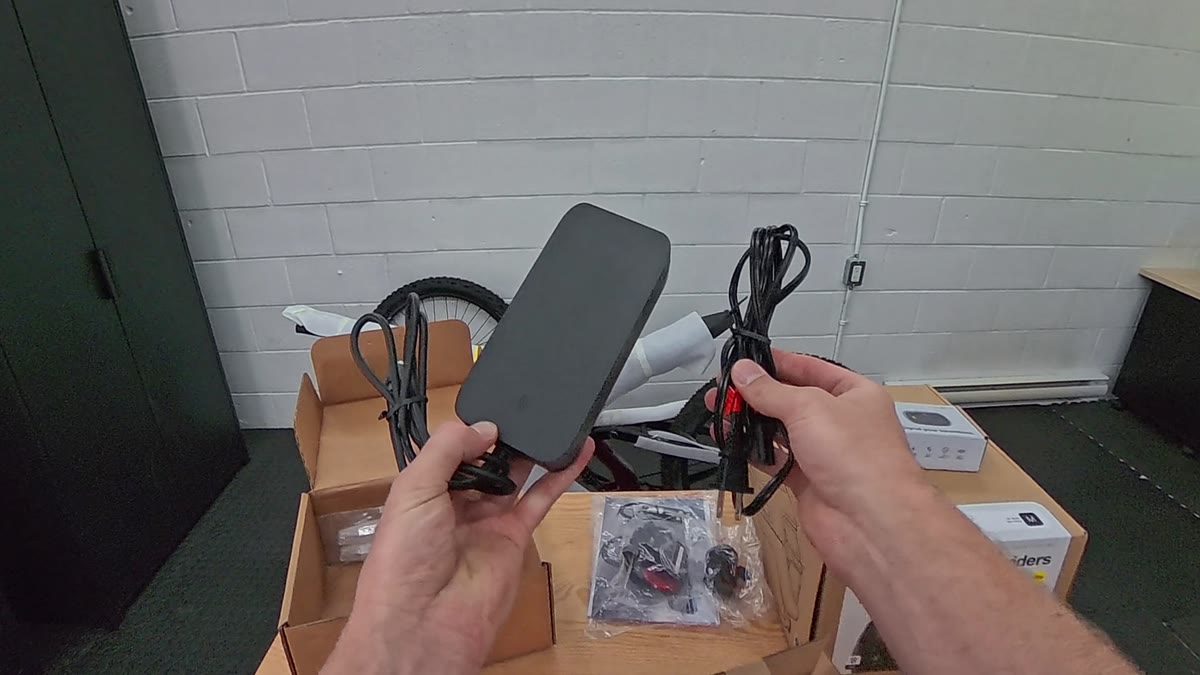
CalculatedFord claims a full charge in 3.5 hours. The math says otherwise: a 15Ah battery on the included 3A charger needs 5 hours at the very least (15Ah divided by 3A), so plan for that. Five hours is still quicker than the 6.3-hour average across our database.
Battery practicality and certification
Fact checkThe 48V 15Ah pack (720 Wh) is integrated into the down tube and does not come out, so you charge on the bike. The Bronco and its battery are certified to the UL 2849 and UL 2271 safety standards, and throughout testing the display's battery readout was accurate.
Braking and Safety
2 tests · 2 ratingsBrake test: 20 to 0 mph
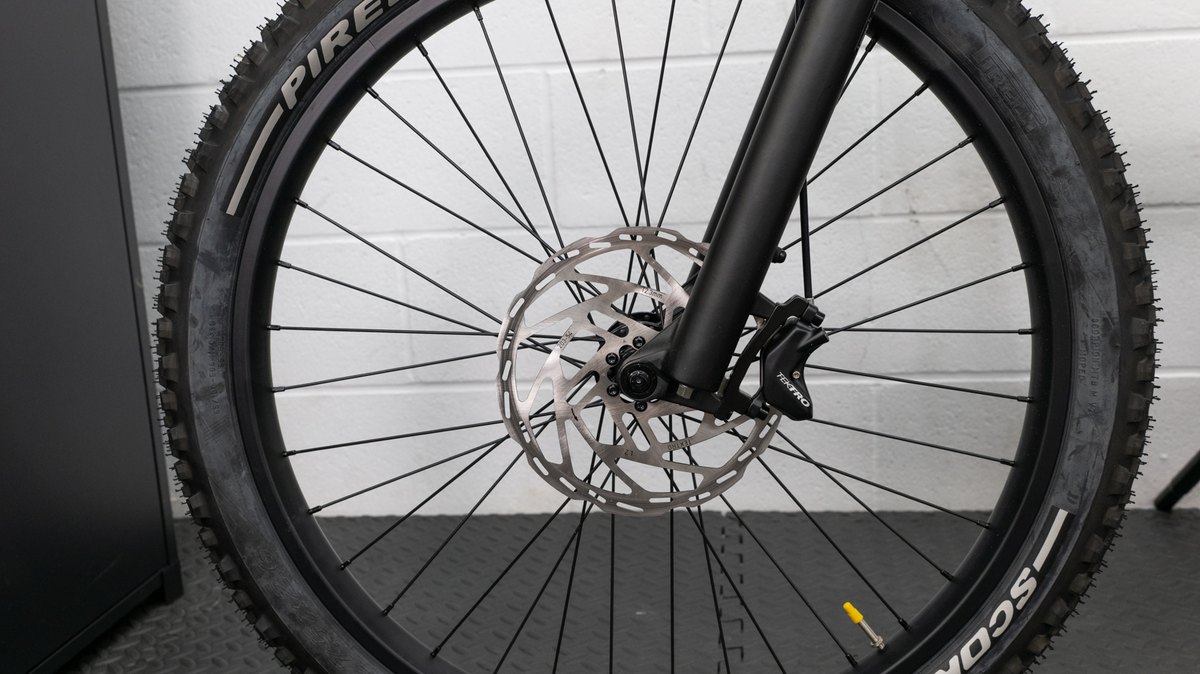
MeasuredTektro Auriga+ levers, HD-E740 four-piston calipers and 203 mm rotors brought the Bronco from 20 mph to a complete stop in 19.5 feet. That isn't a bad result for safety, but it isn't a great one for hardware this size. The Mercedes-AMG needed 20 feet and the Himiway C5 19, while the Revibikes Cougar stopped in 14 feet and the MEELOD DK300 in 16, both on two-piston calipers and smaller rotors. The motorcycle-style e-bikes we have tested average 17.8 feet.
Lights, signals, and visibility
MeasuredThe cockpit houses a 2,000-lumen headlight with high and low beams. On our center-beam measurement it put out 1,541 lux at 15 feet on high beam and 220 lux on low, among the brightest we have measured. An integrated taillight with brake activation sits in the rear. Turn signals are included too, but they live on the MIPS smart helmet, not on the bike. The remote paired quickly, the signals fire instantly and they are bright. Mounting the remote was another story: the one-piece cockpit is tapered and thick, and the only spot the rubber band would fit was right beside the right brake lever.
Ride Quality and Handling
1 descriptor · 9 ratingsRiding the Bronco
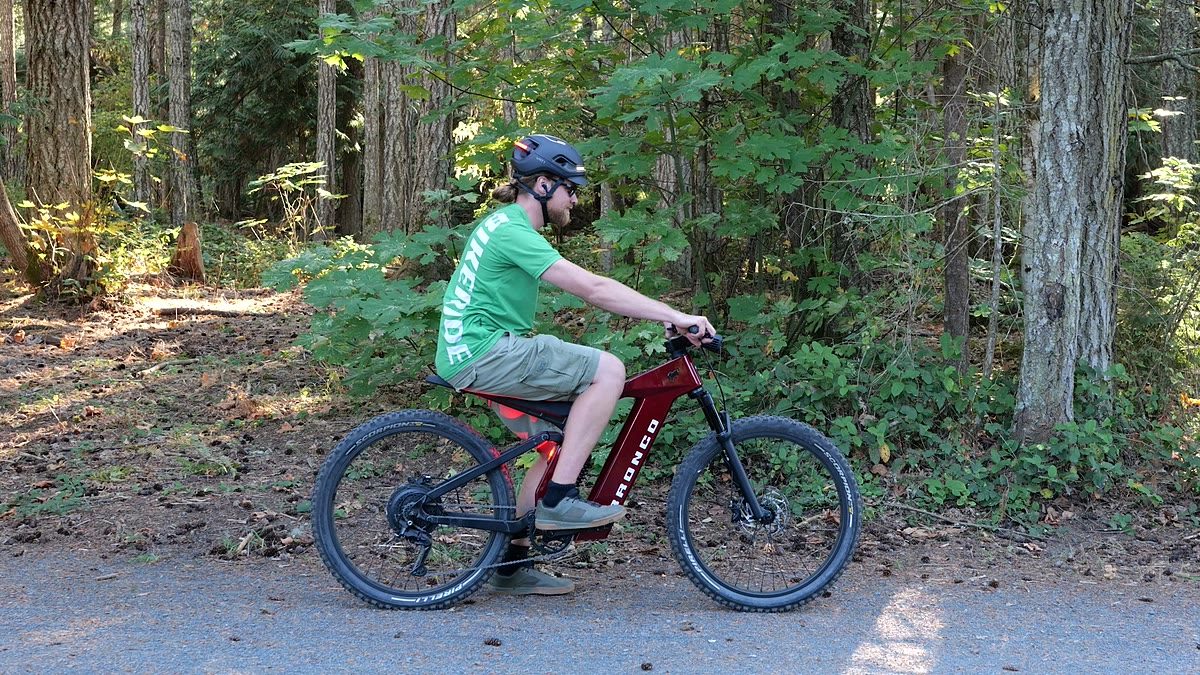
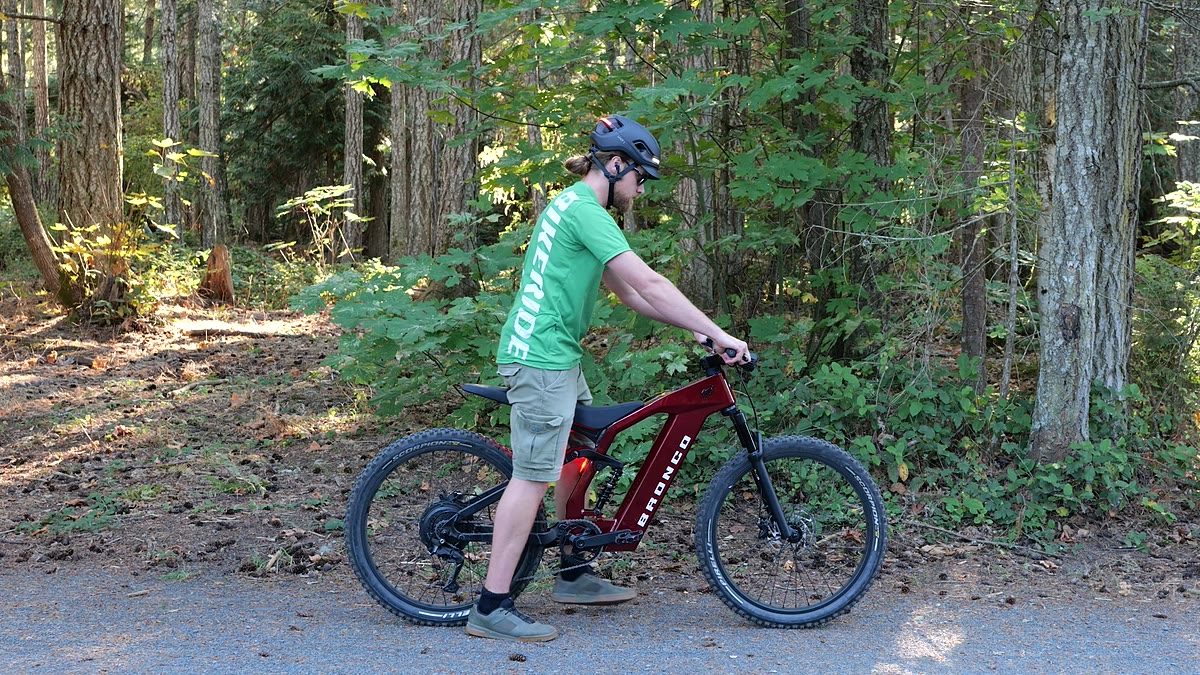
Under power, the Bronco E-Bike feels sluggish. Throttle power is smooth but subdued, and pedaling is where this bike struggles most. Like most motorcycle-style e-bikes it has a fixed seat that sits low, the reach is long, and our knees were so cramped that during the range test we stopped pedaling and used only the throttle.
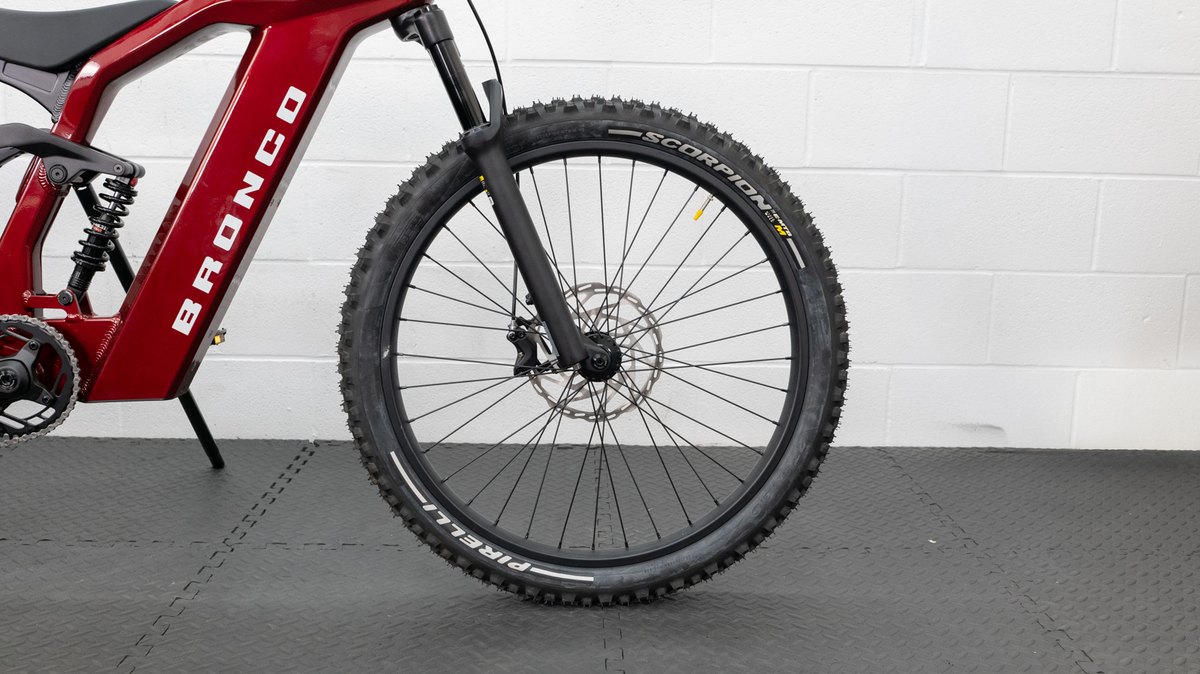
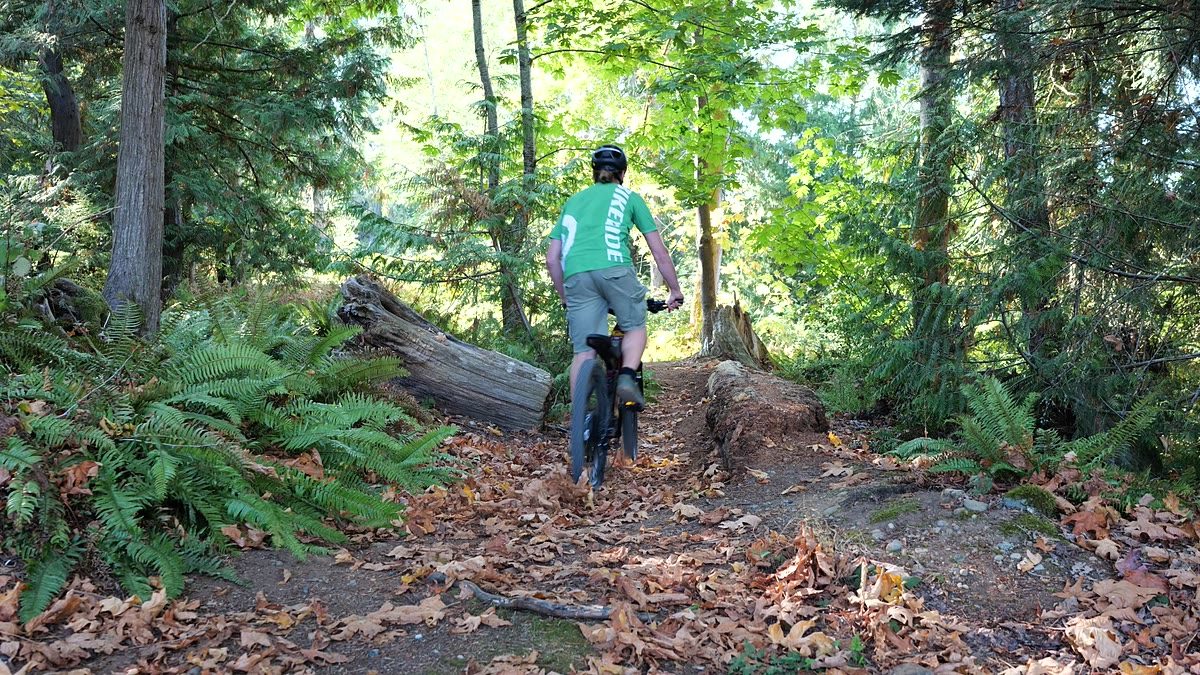
The suspension performed better than expected. On logging roads, gravel and easy dirt paths, the Bronco was comfortable and smooth, more so than the relatively inexpensive components suggested. It is still a far cry from the heavy-duty, go-over-anything suspension Ford describes. Given the weight, the sluggish power delivery, and the pedaling position, we wouldn't take it anywhere technical. What the Bronco does well is smooth out bumpy pavement and light off-road terrain. The Pirelli Scorpion tires grip well and look the part, though without fenders they throw up a lot of trail debris.
Stability at top speed
RatedOn our stability run we ride the bike straight at speed, take our hands off the bars to check for shimmy, shift our weight, corner, and deliberately shake the bike to see whether we can start a wobble or a wander.
Comfort, suspension, and vibration
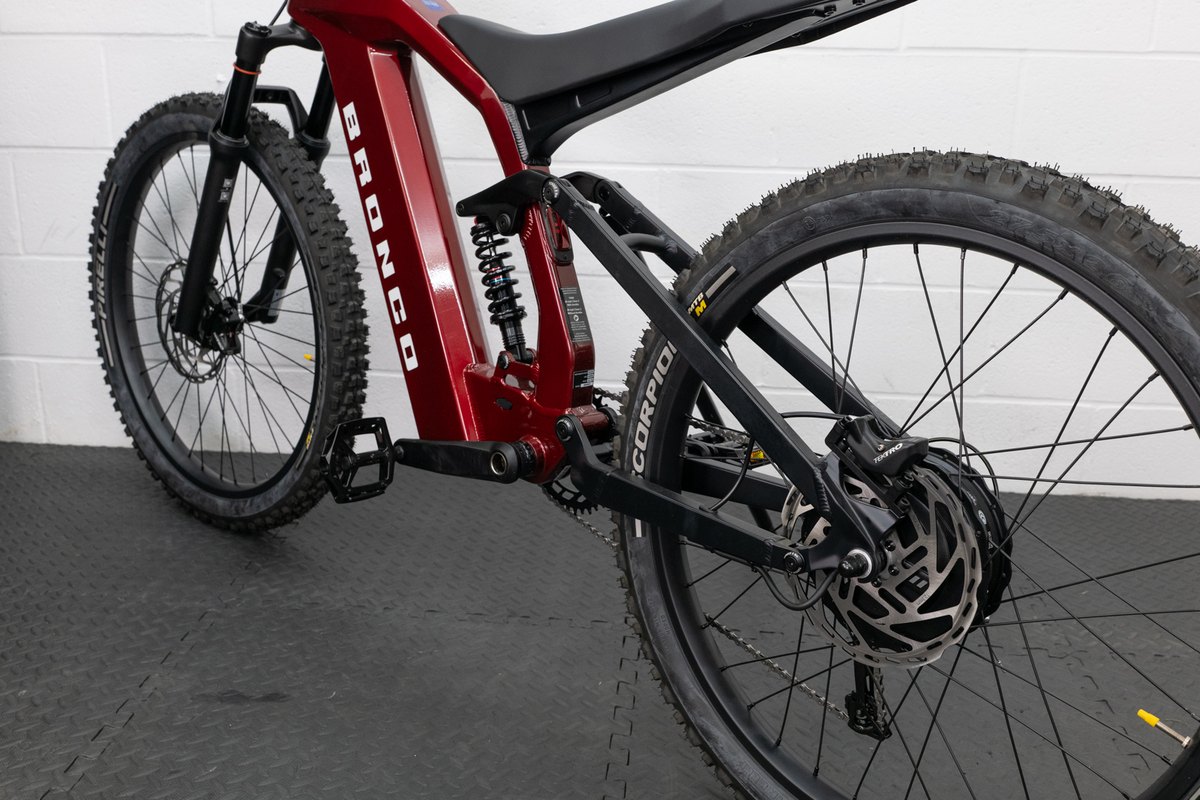
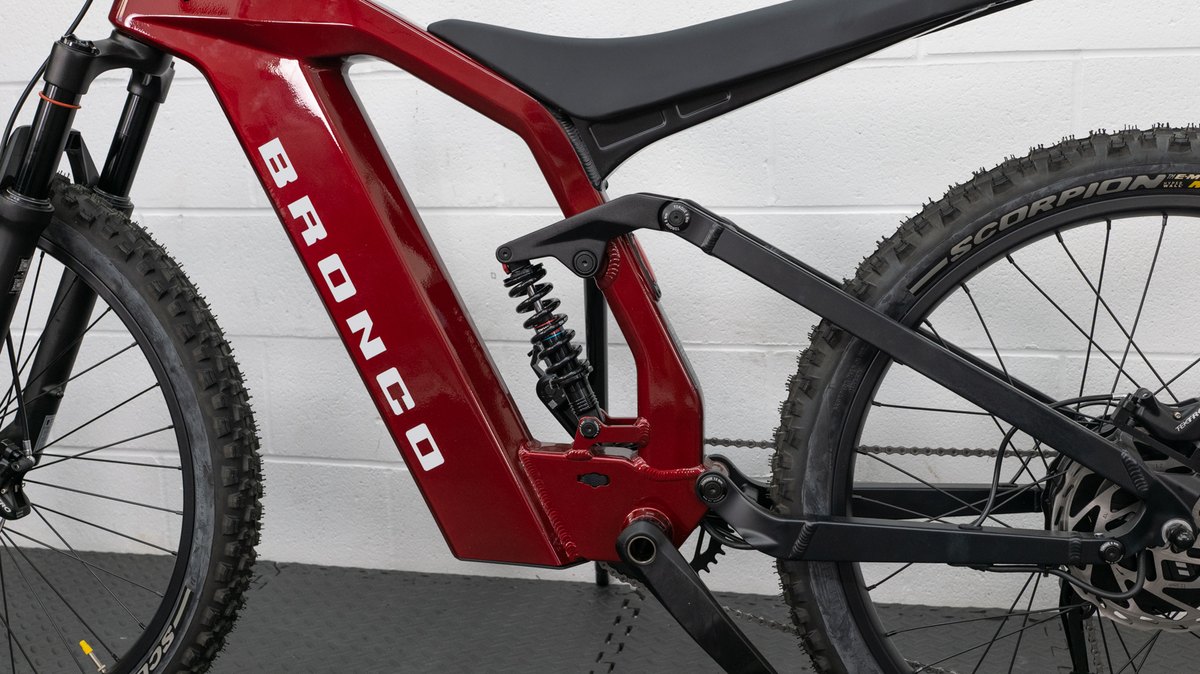
RatedSuspension comes from a Zoom air fork with 120 mm of travel and a lockout, and a coil shock with rebound adjustment and a 50 mm stroke. Together they kept the Bronco comfortable over logging roads and gentle gravel and dirt paths. The fixed moto-style seat sits low, and you adjust your riding position by sliding along it.
Riding position
DescriptorWhere the Bronco sits on the spectrum from fully upright to fully aggressive. The low fixed seat and long reach stretch the rider forward:
Fit and Sizing
2 measurements · 2 checks · 2 ratingsTrue to size?
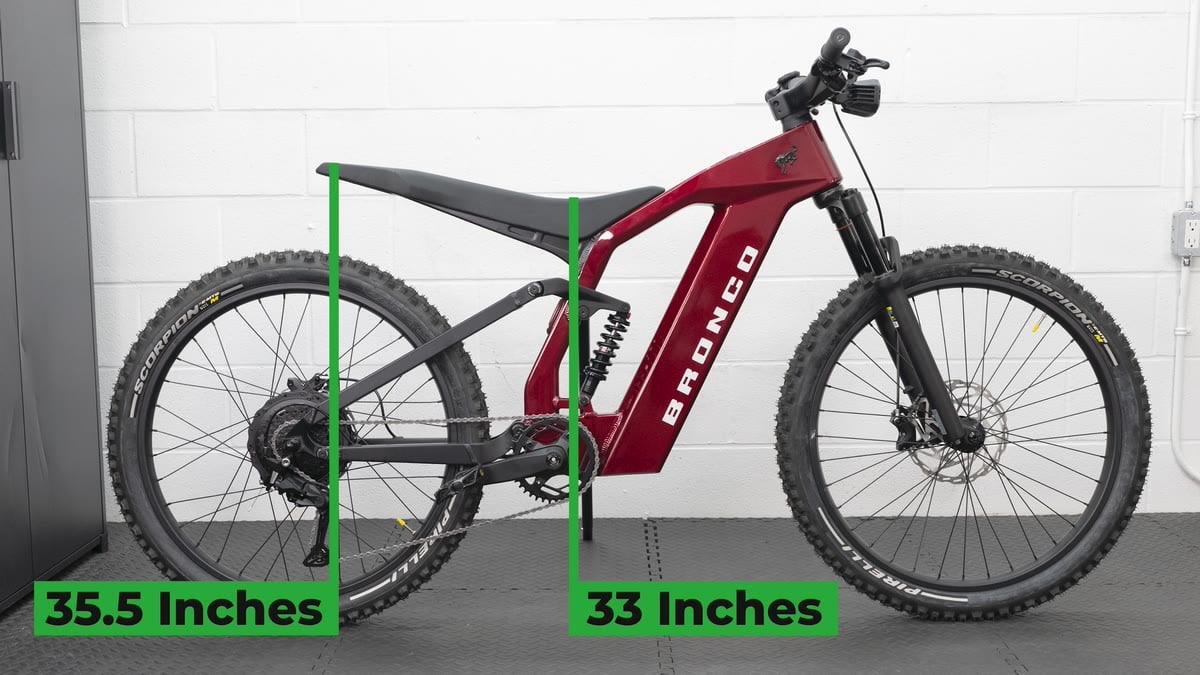
VerdictFord's US product page says the bike fits riders from 5'7" to 6'0", in one frame size, which begs the question of why there aren't more sizes. At 6'0" with a 33" inseam, we sit at the top of that range. We measured the effective seat height at 33 to 35.5 inches, found by sliding along the saddle, and the standover at 33 inches.
| Measurement | Ford claims | We found |
|---|---|---|
| Rider height range | 5'7"–6'0" | Cramped for pedaling at 6'0", the top of the range |
| Seat height | Fixed seat | 33"–35.5" effective, by sliding along the saddle |
| Fits our tester (6'0", 33" inseam) | Inside the claimed range | Yes on the throttle, no for pedaling |
| Claimed height range accuracy | 5" span on 2.5" of effective adjustment | (5 − 2) ÷ 2.5 = 1.2×, inside our 2.0× limit |
| Standover | Not published | 33" (838 mm) |
| Our verdict | One size fits 5'7"–6'0" | Tight at the top end |
Cockpit adjustability
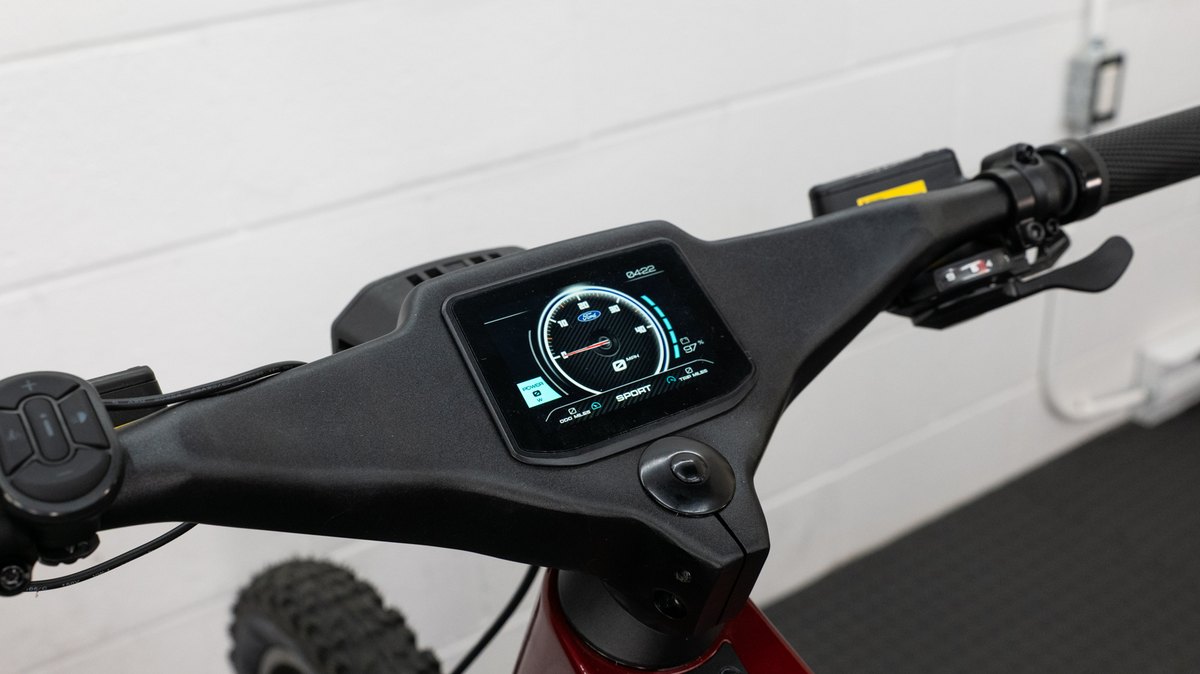
RatedThe one-piece aluminum bar and stem is fixed, the seat is fixed, and the only adjustment left is where you sit on the saddle. The integrated cockpit looks clean, with the display and headlight built in, but there is nothing to tune to your body. You adapt to it.
Build and Components
1 test · 6 ratings · factsWeight, verified
MeasuredFord claims 68 lb. Our scale read 72.4 lb as shipped, with no fenders, rack or kickstand to account for the difference. That is 4.4 lb over the claim, yet the second-lightest bike in this comparison group behind only the Mercedes-AMG (69.4 lb), and well under the 90.6 lb average of the motorcycle-style e-bikes we have tested, several of which are fat-tire machines.
Frame, finish, and integration
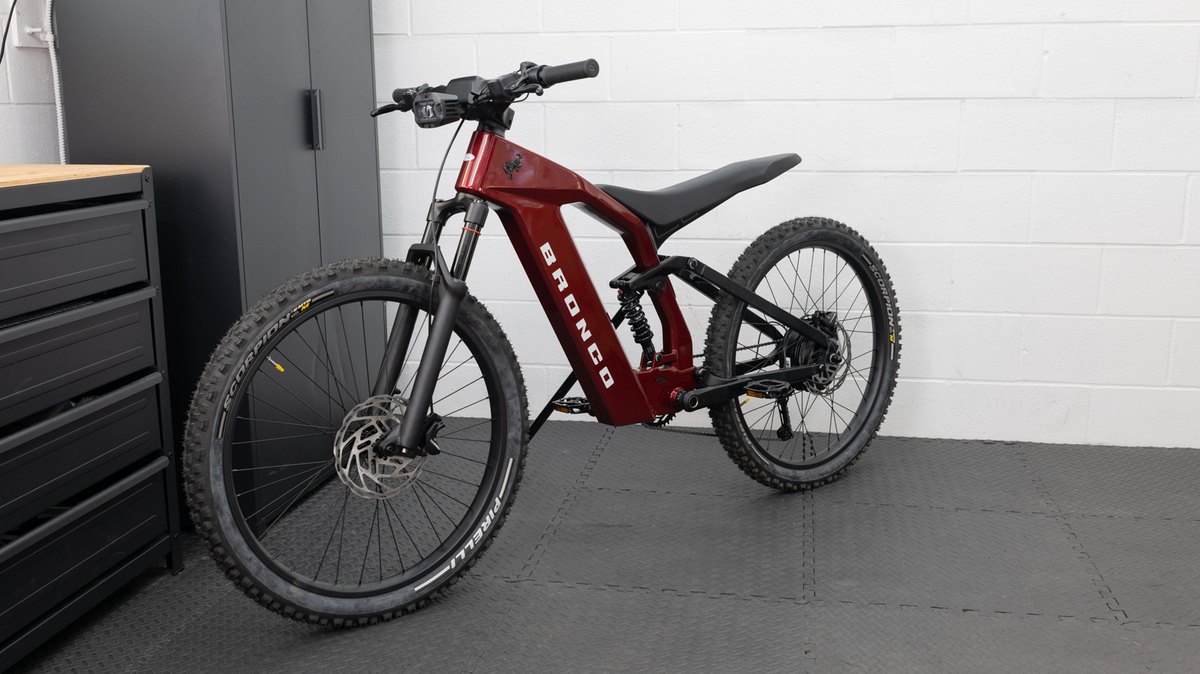
RatedThe 6061 aluminum motorcycle-style frame carries a one-piece bar and stem and an integrated battery and lights, so almost no wiring is on show. Our bike arrived well packaged and without damage.
Drivetrain and shifting
RatedThe drivetrain is a Shimano CUES U4000 9-speed with an 11–36t cassette and a 40t chainring. Because of the riding position, we pedaled far less than usual, so the gearing saw less work than on most bikes we test.
Tires and accessories
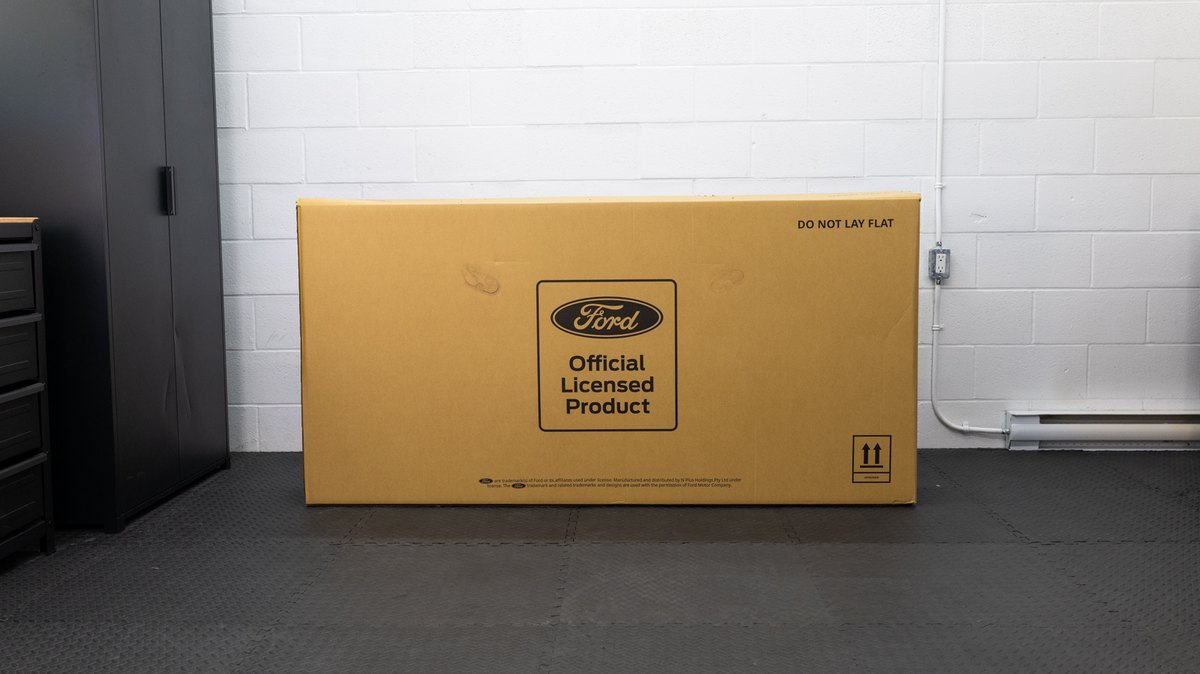
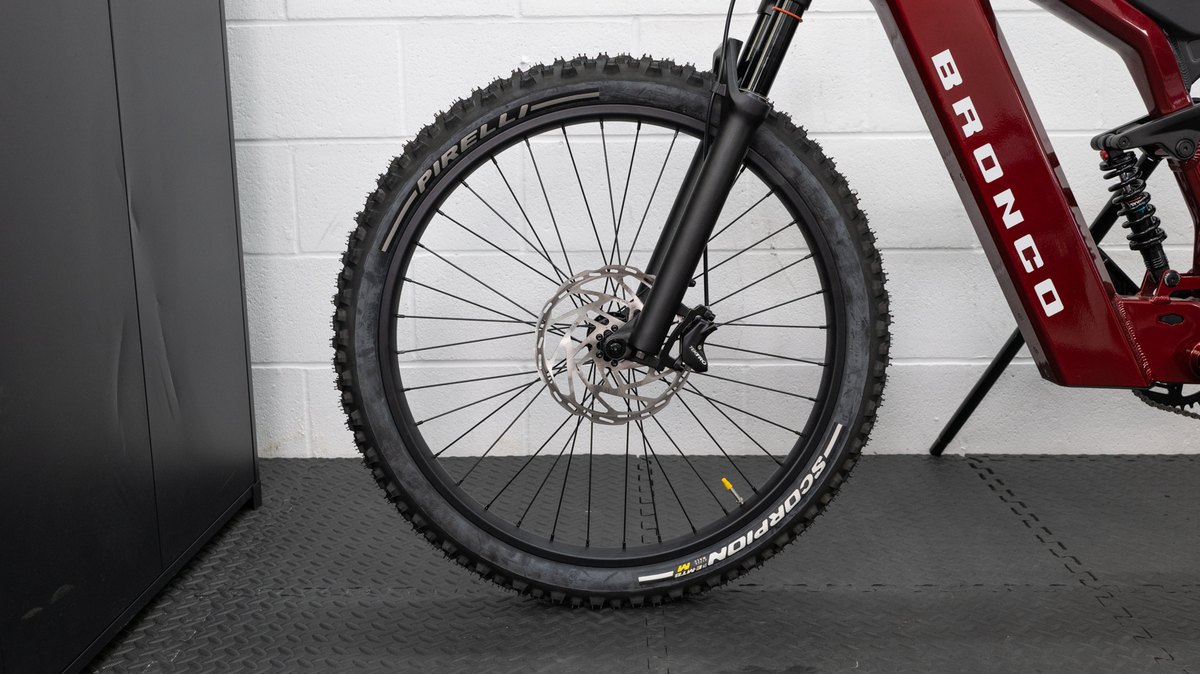
RatedThe 27.5"×2.6" Pirelli Scorpion Enduro M Hardwall tires grip well and look the part, though without fenders they throw up a lot of trail debris. The accessory list is short for the price: no fenders, no rack, no kickstand. What you do get is the MIPS smart helmet with its turn-signal remote, the 2,000-lumen headlight and the brake-activated taillight.
Display, Controls, and App
2 ratings · factsDisplay and controls
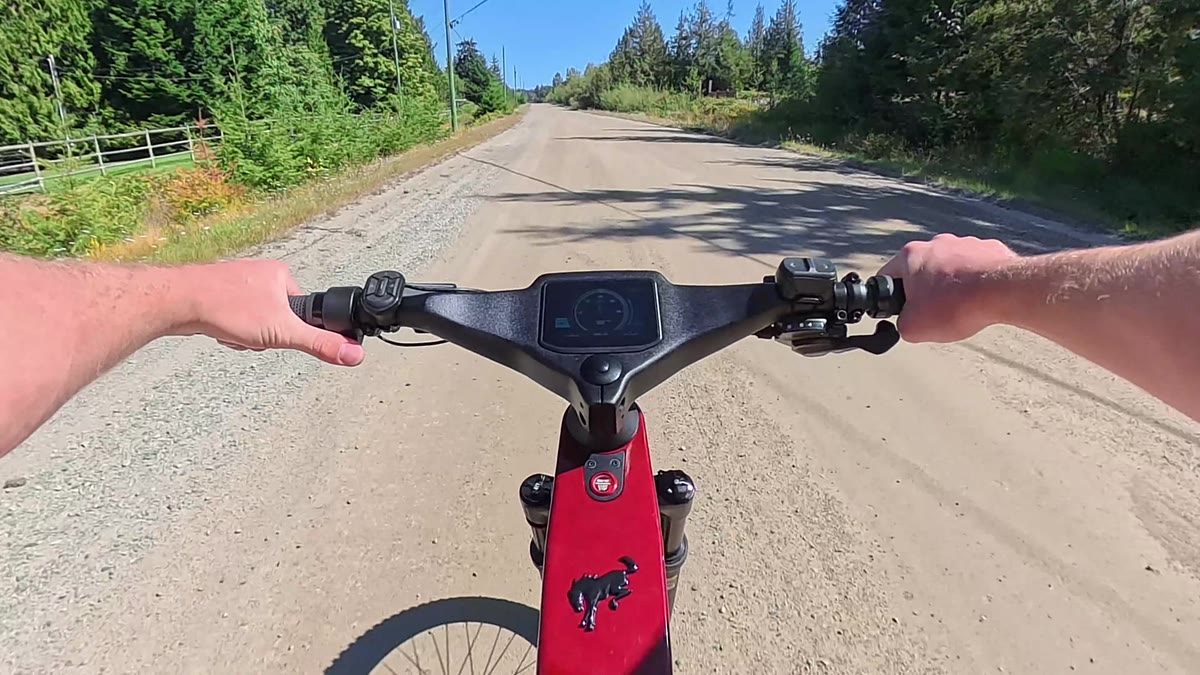
RatedA 3.5-inch full-color screen is built into the one-piece cockpit, with graphics styled after Ford's infotainment system. Throughout testing its speed and battery readouts were accurate, and we could read it in bright sunlight. The power modes are stepped through on the bar. The turn-signal remote for the helmet is the odd one out, with nowhere to mount it on the thick, tapered bar but beside the right brake lever.
Companion app
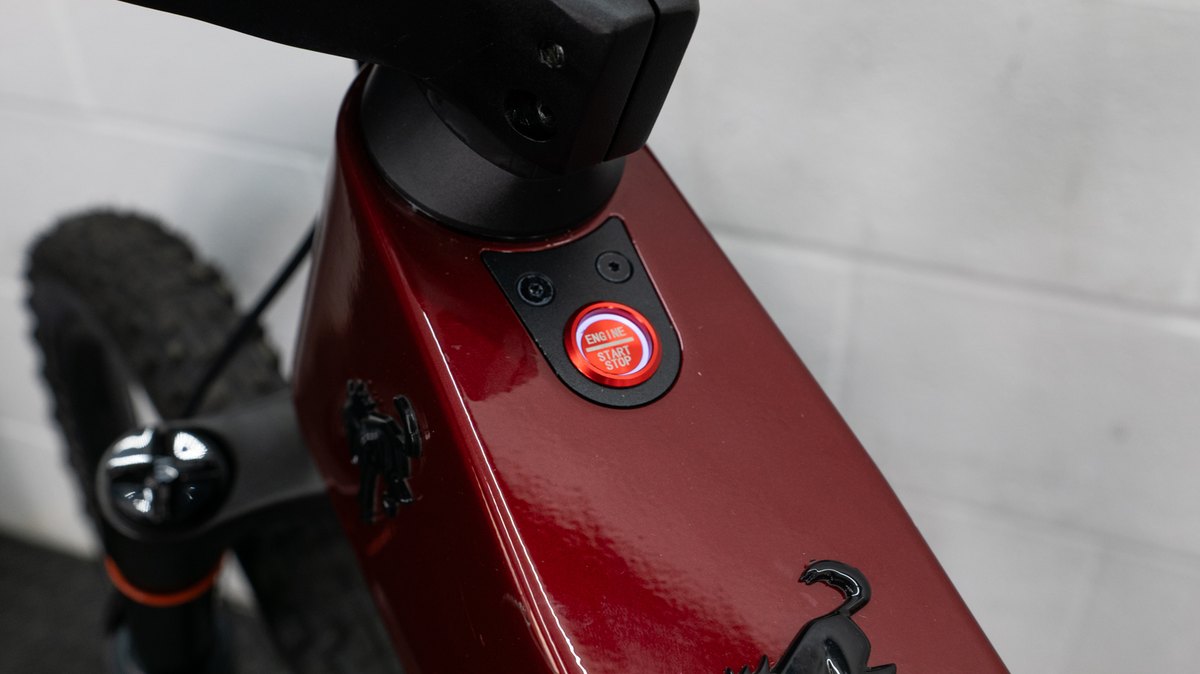
Fact checkThere is no app. The four power modes, Eco, Normal, Sport and Baja, are selected on the bike, and the helmet's turn signals are driven by the handlebar remote.
Ownership, Practicality, and Value
1 test · 6 ratings · factsAssembly and setup
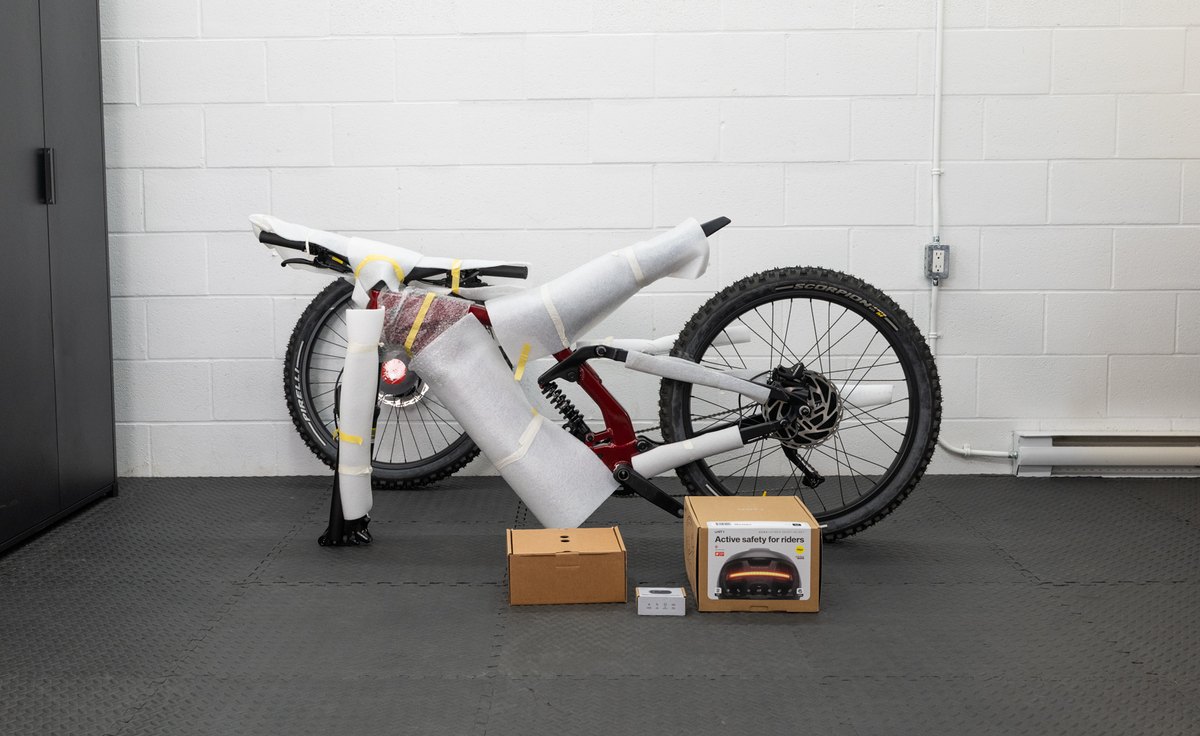
RatedThe Bronco arrived well packaged and, like the Mercedes-AMG from the same manufacturer, mostly assembled. Setup was easy: all we had to install was the handlebar and stem, the front wheel and the front light. The assembly time was not recorded on this bike.
Support response, tested
MeasuredEvery brand we review gets the same test. We send one short, everyday support question through the brand's public support channel, from a regular customer account with no BikeRide affiliation, so the test is equal for everyone. We then time how long the first useful reply takes, counting weekday hours only. For the Bronco the first useful answer arrived after 51 hours, against a 17.7-hour average across the brands we have tested.
Serviceability and parts ecosystem
RatedThe mechanical side is standard: a 9-speed Shimano CUES drivetrain, chain, Tektro brake pads, tubes and 27.5" tires are available everywhere. The electrical side and cockpit are proprietary to n+, a relatively new company in the e-bike space, so long-term warranty handling, customer support and parts supply are unknowns, and the proprietary components may be hard to source in the future.
Component level for the price
RatedAt the Bronco's price, the spec sheet is a thin one.
Value for money
RatedWeighing everything we measured against the price at the time of publication: a comfortable ride, 31 miles of range, bright integrated lights and a MIPS helmet on one side, and on the other the slowest acceleration in the group and budget suspension components. What you are paying for is the Ford Bronco branding. If you are a Bronco owner with plenty of cash who wants a brand-matched bike for the campground and easy trails, you may be satisfied. If you want true performance or off-road capability, this isn't the bike.
Full test results
Every measurement from this review in one table, against the average of similar bikes and the average of all 88 e-bikes we have tested.
| Test | Ford BroncoThis bike | Average of similar bikesSimilar | BikeRide averageAll bikes |
|---|---|---|---|
| Motor and performance | |||
| 0–20 mph, throttlevs. 33 other 750W hub-motor e-bikes | 11.0 s | 9.6 s | 10.7 s |
| 0–20 mph, max pedal assistvs. 34 other 750W hub-motor e-bikes | 10.0 s | 8.1 s | 8.4 s |
| Gradual hill climb, 20 mph-capped runsvs. 21 other 750W hub-motor e-bikes | 3:03 | 3:09 | 3:18 |
| Steep hill climbvs. 31 other 750W hub-motor e-bikes | 2:27 | 2:28 | 2:36 |
| Speedometer deviationvs. 6 other e-bikes | 0% | +5% | +5% |
| Motor noise @ 20 mph, unloadedvs. 6 other e-bikes | 70.9 dB(A) | 68.0 dB(A) | 68.0 dB(A) |
| Assist engagement delayvs. 6 other e-bikes | 0 crank rev | 0.4 crank rev | 0.4 crank rev |
| Range and charging | |||
| Range (max assist)vs. 6 other motorcycle-style e-bikes | 31.35 mi | 32.7 mi | 30.5 mi |
| Range vs claimedvs. 6 other motorcycle-style e-bikes | 52% | 49% | 55% |
| Efficiencyvs. 6 other motorcycle-style e-bikes | 23.0 Wh/mi | 33.6 Wh/mi | 25.2 Wh/mi |
| Charge time 0→100%vs. all e-bikes tested | 5.0 h | 6.3 h | 6.3 h |
| Braking and safety | |||
| Brake test, 20–0 mphvs. 6 other motorcycle-style e-bikes | 19.5 ft | 17.8 ft | 19.3 ft |
| Headlight @ 15 ft, high beamvs. 6 other e-bikes | 1,541 lux | 873 lux | 873 lux |
| Build and ownership | |||
| Measured weightvs. 5 other motorcycle-style e-bikes | 72.4 lb | 90.6 lb | 74.4 lb |
| Support response, tested (weekday hours)vs. 29 other brands | 51 h | 17.7 h | 17.7 h |
Similar bikes: for the acceleration and hill-climb tests, e-bikes with a 750W nominal hub motor; for range, efficiency, braking and weight, motorcycle-style e-bikes; for the other rows, every e-bike we have tested; the support test is averaged per brand, since every brand is tested once. The gradual-hill row compares runs made with the 20 mph throttle cap in play, as the Bronco's was. Charge times are calculated from charger output and battery capacity. Not measured on this bike: medium-assist range, battery weight (integrated pack) and assembly time.
Detailed specs
As published by Ford for the Bronco E-Bike, with our component notes. Values we verified or debunked in testing are covered in Claimed vs. measured.
| Electric bike class | Class 3 (28 mph pedal assist, 20 mph throttle) |
|---|---|
| Motor | Unbranded 750W rear hub |
| Max torque | 85 Nm (claimed) |
| Battery | 48V 15Ah (720 Wh), integrated |
| Range claimed | Up to 60 miles |
| Top speed | 28 mph (GPS-verified) |
| Throttle | Yes, to 20 mph |
| Pedal assist | 4 modes: Eco, Normal, Sport, Baja |
| Sensor | Torque |
| Charger | 54.6V 3A |
| Charge time | 5 hours, calculated (3.5 hours claimed) |
| Display | 3.5" full-color, integrated in the cockpit |
| Certification | UL 2849 (electrical system), UL 2271 (battery) |
| Water/dust rating | IPX4 bike (motor IPX5, electronics IP66) |
| Warranty | 2 years |
| Frame | 6061 aluminum, full suspension, one size |
|---|---|
| Fork | Zoom air, 120 mm travel, lockout |
| Rear shock | Coil, 50 mm stroke, rebound adjustment |
| Brakes | Tektro Auriga+ levers, HD-E740 4-piston hydraulic, 203 mm rotors |
| Drivetrain | Shimano CUES U4000 9-speed |
| Chainring / cassette | 40t / 11–36t |
| Rims / tires | 27.5" 36H alloy / 27.5" × 2.6" Pirelli Scorpion Enduro M Hardwall |
| Handlebar | One-piece 6061 aluminum bar and stem |
| Grips | Lock-on |
| Saddle | Motocross-style, fixed height |
| Pedals | Aluminum platform |
| Lights | Integrated 2,000-lumen headlight (high/low beam), integrated taillight with brake light |
| Fenders | Not included |
| Kickstand | Not included |
| Payload capacity | 287 lb (claimed, not tested) |
| Included | MIPS smart helmet with turn-signal remote |
Geometry details
Ford publishes no geometry chart for the Bronco, so these are our own measurements of the one frame size (claimed to fit 5'7"–6'0"). ✓ measured = measured on our test bike.
| Measurement | One size (claimed 5'7"–6'0") | |
|---|---|---|
| Reach | 20.08" (510 mm) | ✓ measured |
| Stack | 21.65" (550 mm) | ✓ measured |
| Standover height | 33" (838 mm) | ✓ measured |
| Seat height, min–max (fixed seat, effective) | 33"–35.5" (838–902 mm) | ✓ measured |
| Wheelbase | 49.5" (1,257 mm) | ✓ measured |
Video review
Watch Scott's full 10-minute review of the Ford Bronco E-Bike, including footage from every test above, on BikeRide's YouTube channel.